FACIS
Since November 2024, eco – the Association of the Internet Industry has been responsible for managing the FACIS project as part of the European cloud infrastructure initiative IPCEI-CIS/8ra. 8ra is an initiative by the EU and its Member States to establish a European cloud infrastructure, enabling companies to exchange data securely and digital services to interoperate seamlessly across provider and national borders. FACIS (Federation Architecture for Composed Infrastructure Services) contributes to this by developing practical solutions, common frameworks and concrete use cases. The project is funded by the German Federal Ministry for Economic Affairs and Energy (BMWi) with around 6.8 million Euro until early 2027.
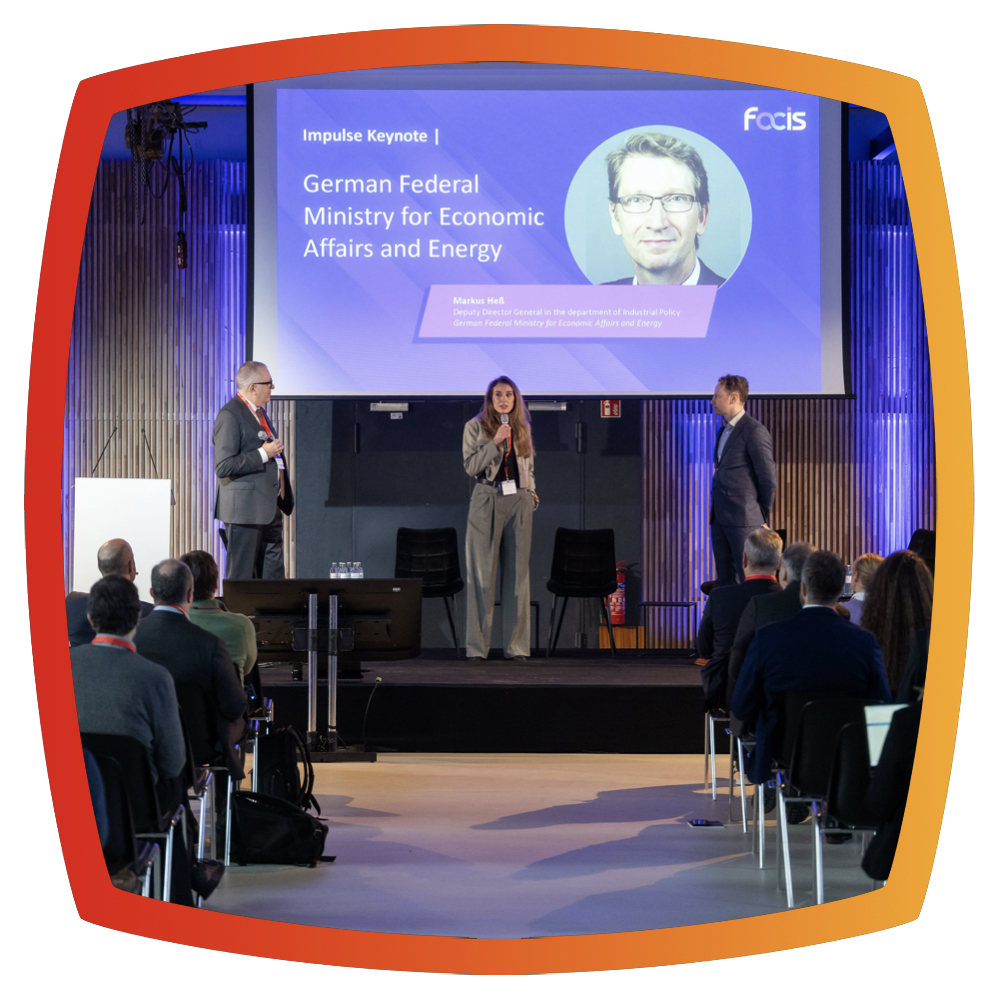
A key focus in 2025 was on so-called Service Level Agreements (SLAs). These are agreements on the quality of digital services, for example regarding the availability or response time of IT services. Together with partners, FACIS has developed proposals for uniform rules for SLAs. The aim is to make collaboration more transparent and to make performance more comparable and measurable across providers and borders (see SLA Governance & SLA Taxonomy). The proposal for a common set of rules was presented in November 2025 at the FACIS event “Next Generation SLA Management” in Berlin. Workshops – both in-person and online – had already been taking place throughout the year in the run-up to the event. In these sessions, cloud providers, companies and organisations discussed which requirements needed to be taken into account in such a set of rules.
In addition, FACIS has been working on so-called Federation Architecture Patterns (FAPs). These are standardised process models or “blueprints” that show how organisations can securely interconnect their various digital services. An important milestone was reached in 2025 with the first of these “blueprints” – the “Partner Onboarding FAP”. It describes how new partners can be integrated into a shared digital ecosystem in a structured and secure manner. This should make collaboration between different providers faster and easier in future. At the end of last year, three further Federation Architecture Patterns were launched via calls for tenders; eco has taken on the role of project office, whilst external partners are responsible for the technical implementation of the developed solutions.
To demonstrate how federated digital ecosystems can already function in practice today, FACIS has also developed an application example from the aviation sector. In this scenario, aircraft, airlines, airports and other partners securely exchange important operational and maintenance data across various cloud systems. This allows information to reach where it is needed more quickly – for example, in the event of technical problems or when planning maintenance work. As a result, processes can be made more efficient, down time reduced and new digital services enabled for safe and smooth flight operations.
Further information at: www.facis.eu